
Good News! Alan Krockey’s Highly Entertaining Book, “Straight Outta Skokie: The Krockey Chronicles 1968,” Is the First of a Trilogy
Reviewed by Anne L. Holmes for the NABBW.com and www.BabyBoomer.org
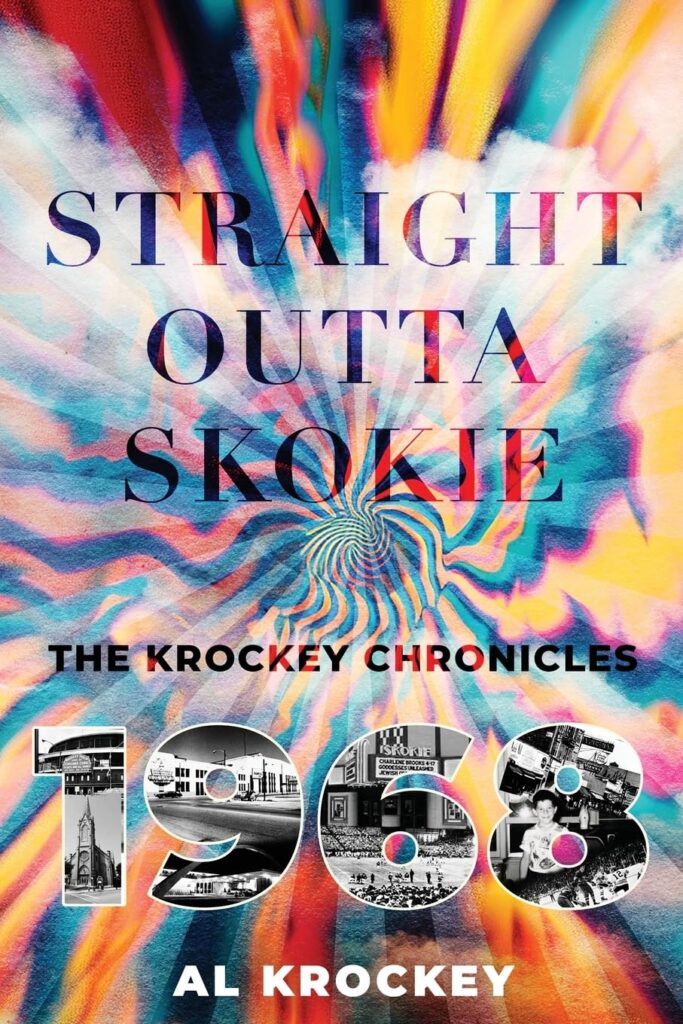
Straight Outta Skokie: The Krockey Chronicles: 1968
This fascinating autobiography is a fun and educational read, especially if you are a Baby Boomer who remembers the turbulence of 1968, as this reviewer is and does. It is the first of a trilogy about the life of Al (Alan) Krockey (pronounced like “crockery”), who we learn was “raised in a working-class Jewish family that often struggled to make end meet.”
He is a high school student and resident of Skokie, Illinois, a bedroom community to Chicago as the story begins. The book opens on a Saturday, with Al heading to work at a highly successful Wrigley Field souvenir hawking business run by two well-connected men, Eddie Shay and Al Stein.
Krockey quickly tells readers that Eddie and Al were also known as the Lettuce Kings at the South Water Market and that due to their association with Sergeant Donny Hayes, who ran the task force for the Chicago Police in and around Wrigley Field and for the price of “a small daily donation,” they had managed to corner the five best souvenir hawking locations at Wrigley.
In short order, the reader then also learns the origin of Wrigley Field’s “Bleacher Bums,” that Eddie and his partner will eventually open a large souvenir store on the southeast corner of Clark and Addison and that Krockey and his co-workers were daily paid a highly motivational 25% (raised to 30% in 1969) of their gross sales. (Which, when I think about it, is a lot more than the $1.25/hour I was paid in 1968 to work in fun head shop on State Street, in Madison, Wisconsin!)
The book, packed with minute details that help the reader to remember what life was like back then, includes a lot of black and white photos of places, people and mementoes, and covers the year 1968, a year often considered to be one of the most turbulent and traumatic years of the 20th century — especially for those living in the middle of the United States.
If you are not familiar with the community of Skokie, Illinois, it is a diverse and family-friendly village in Cook County, Illinois, located about 15 miles from Chicago. It is known for excellent schools, a vibrant downtown, a strong sense of community and economic progress.
You may recall that 1968 was marked by many sensational historical events, including Martin Luther King’s assassination, as well as the passage of the Civil Rights Act of 1968. Nationally, King’s assassination led to a huge wave of violent protests, which Krockey discusses at length, because the protest in Chicago area personally affected him and his friends and family.
Both events happened in April. Then June of 1968 brought us the assassination of Robert F. Kennedy, who was a leading Democratic presidential candidate. This led to Vice President Hubert Humphrey winning the Democratic nomination at the 1968 Democratic National Convention in Chicago, which will forever go down in history for the wave of violent protests it unleashed. This time the protests were mostly between young antiwar demonstrators and the police.
Later came the 1968 presidential election, which turned into a referendum on the Vietnam War. Other political events of 1968 included civil rights disturbances at the nearby University of Wisconsin-Madison, and ongoing campus unrest across the country as college students protested the Vietnam War, campus ROTC programs and the draft.
Personally, 1968 brought Al and his friends opportunities to party with girls, teen-aged rebellion, a few brushes with the law — mostly related to importing and selling marijuana and other drugs, and — though he wasn’t a good student — the ever-present need to remain in school in order to avoid the draft. What made it all a bit more fun and exciting was that all if the above was accompanied by wonderful new music which he enjoyed live in clubs, as well as at concerts, on vinyl and even via 8-track tape.
Reviewer’s personal note: We are so excited to have the opportunity to review this true Baby Boomer memoir/autobiography. Especially because we Boomers, born between 1946 and 1964 and the older too us are now in our 80s. I loved reading Krockey’s book preface, where he explains how in March 2020, during the Covid lockdown, he found himself sitting alone on the twenty-first floor of his Chicago lakefront high-rise, sipping coffee and staring out over Lake Michigan. With the city on lockdown and because he is such a “people person” by nature, he vastly missed having much human connection. Then a chance comment about Kaufman’s deli in Skokie made by a neighbor on the elevator flipped a switch in him. Soon he was driving to Skokie and soaking up all the old sights of his childhood. This story really related with me, because I too made a trip back to suburban Madison, Wisconsin neighborhood I grew up in around the same time. And as Al says in his preface, “Just like that, I was no longer a seventy year od man, isolated in a pandemic. I was a kid again in Skokie, where the world had clear, simple boundaries…
If this preface moves you, the way it did me, I urge you to start memorializing your own youthful memories. We need to share them with our children, grandchildren and the kids of the future.
The rest of the planned trilogy is still to be published.
Book Two, “Straight Outta Skokie: Krockey Road Ahead: 1969,” will be published later this year (2026). It continues to deal with big highs and heavy lows, of life in the United States in the late 1960s. The big highs for Al include events that shaped his efforts to carve out his place in the rapidly changing world, such as being onstage at Woodstock (remember he is a huge music fan) a sun-soaked adventure in Jamaica, and as a result of his love of music, the spark of an idea that would eventually blend music and his entrepreneurial skills — The Record Shack. 1969 is the year Al learns that coming of age means stepping boldly into the unknown.
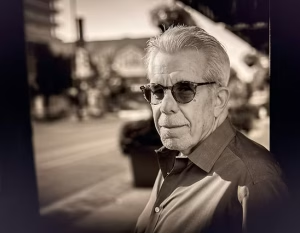
Al Krockey today. Author provided photo
Book Three, “Straight Outta Skokie: The Record Shack Years: 1970-1974,” will be published in 2027. The teaser at the end of Book One (1968) tells us that it will “dive headfirst into the gritty, electric world of a young dreamer who turns a wild idea into a legendary record store.” Readers will enjoy discovering how The Record Shack becomes more than just a store, it becomes a front-row seat to an era exploding with music, rebellion and risk. At its heart, Al Krockey leans that running a store means juggling business, chaos, and survival. As competition grows and pressure mounts, the ultimate question looms: Is it time to sell the dream – or double down on it?
History tells us Al Krockey left the music business in the early 1980s. I don’t know why. But that didn’t mean he stopped evolving, becoming. As he sys at the end of his first book, “The Krockey Chronicles 1968,” he’s still becoming. He went on to build a successful career in insurance consulting, becoming vice-president of Globe Midwest Adjusters International, according to his LinkedIn.com profile.
There, he and his team provide urgent claim assistance and loss management to clients impacted by catastrophes such as fire and flooding throughout Chicago and the Midwest. “We are consumer advocates, working on behalf of commercial property owner, property management companies, hotels, restaurants, manufacturing and distribution companies, small businesses and homeowners,” he says. “The interest of our clients takes primacy over all else.”
Having read this book, I have to wonder whether or not the seed for Krockey’s eventual decision to enter into the insurance catastrophe protection business stems from an unfortunate business event he funded in 1968. You’ll have to read the book for the details, but it involves an 18-wheeler semi truck full of Christmas trees which drove off a bridge in Mauston, Wisconsin. The cargo and truck were lost, the driver who was both tired and driving while impaired, was nearly killed. The truck was insured, but not the cargo.
Then at 68, he reached the final table of a World Poker Tour Main Event, and at 75 he took a turn at becoming an author. His is a life that has been shaped by grit, reinvention, and a love for the hustle–whether in music, business or cards.



Leave a Reply
You must be logged in to post a comment.