In a Malibu State of Mind, Linda Ballou Shares the Amazing Tale of May Rindge, the “Queen of Malibu,” & Other Reasons Why You Should Visit
By Linda Ballou for the NABBW
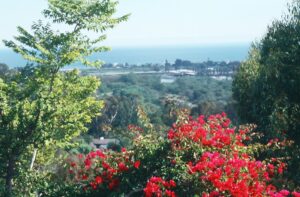
This current day view of Malibu shot from Serra Retreat is certainly not the view the Rindge family enjoyed in the late 1890s. Photo courtesy of Linda Ballou.
Malibu is uniquely isolated from the rest of the coastal towns along the Pacific Ocean primarily because of the efforts of one feisty and highly accomplished American businesswoman, Rhoda May Knight Rindge, also known as May Rindge or May K. Many people call her the “Queen of Malibu,” or alternately the “Founding Mother of Malibu.”
In 1893, May’s husband, Fredrick Rindge, purchased the 13,315-acre Spanish Land Grant, which he dubbed Rancho Malibu. His “corner of paradise” enjoyed a sea breeze, the shade of stately oaks in the mountains, trout filled streams, and 23 miles of coastline. The Rindges built their home beneath what is now Serra Retreat.
For a time, they lived there in splendid isolation. Then the Southern Pacific Railroad Company determined to cross their land. Why? Because the straightest line between their terminal at Santa Monica and their desired expansion to Santa Barbara and the Pacific Coast ran through the Rancho Malibu acreage.
The railroad giant put enormous pressure on them in their quest to access the land occupied by Malibu Rancho. Frederick Rindge took up the fight, building a gate with armed guards to keep people off his property, but when he died suddenly at age 48, the task was left to May.
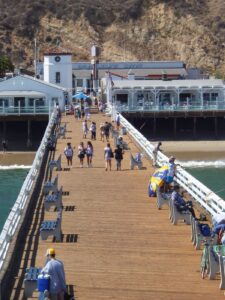
Malibu Pier as it appears today. Hard to imagine it was originally built to transport cattle. Photo by Linda Ballou.
Freshly widowed with three young children to support, May rose to the challenge and fought back, using an obscure law that said only one railroad could have a track in a given area. She built her own railway called the Hueneme, Malibu and Port Los Angeles Railway, and used it to take her cattle to the pier she built beside Malibu Lagoon. Today we know May’s pier as the Malibu Pier. All told, she spent her last twenty years and all of her vast fortune preventing the railroad giant from crossing her land.
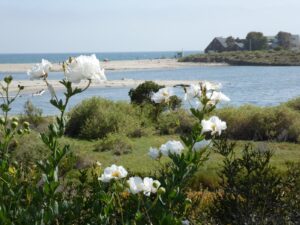
A peaceful view of Malibu Lagoon shot from Adamson House. Photo courtesy Linda Ballou.
Years later, May’s son-in-law built the Adamson House, a Spanish Colonial manor overlooking the surfing mecca Surf Rider’s Beach, as well as Malibu Lagoon. This mansion’s design utilized gorgeous glazed clay tiles created by May’s Malibu Pottery Company. She developed this business after she discovered rich clay deposits on her property.
At its peak, before the pottery company was destroyed by fire just a few years after opening, 125 employees worked there, producing 30,000 square feet of tile monthly.
Women hand-painted the tiles using patterns and designs inspired by books from May’s personal library. The factory not only produced flat tiles for ceilings, walls and floors, but also ceramic tile fountains, murals, urns and bathroom built-ins, like soap dishes and toothbrush holders. You can still enjoy seeing the tiles today in several public buildings, as well as on fountains featured on the manicured grounds of the Adamson House, which is open to the public. Docent-led tours of the home are free.
Despite her success with the pottery company, in 1928 May still found herself land rich and cash-poor despite an estimated 1928 net worth of many millions. The situation was due to her extensive and ongoing court battles, focused on maintaining ownership of her land. Looking again for income opportunities, May’s next venture was the Malibu Movie Colony. A true entrepreneur, she saw a need and filled it, building cottages on her beachfront land, which she leased to pioneer Hollywood actors including Gary Cooper, Bing Crosby, Clark Gable, Carole Lombard, Anna Q. Nilsson, Mary Pickford, Gloria Swanson and Lana Turner.
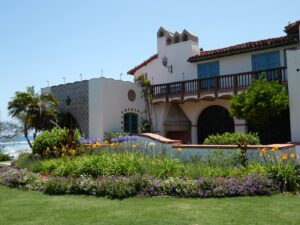
A view of the Adamson House Garden. Photo courtesy Linda Ballou.
But when the Depression hit in 1929, followed by a kiln fire in 1930 which destroyed Malibu Pottery, she was plunged into further debt, could not afford to complete what was to have been Rindge Castle, selling it instead to the Franciscan Order, who dubbed it Serra Retreat. By 1938 May was bankrupt, her relationship with her children fractured, because they blamed her for poor financial management. Sadly, this pioneering woman died alone and broke in 1941.
Serra Retreat, still a Franciscan monastery, remains on a promontory overlooking Malibu. Today it is a restful stop with manicured garden paths that visitors can enjoy by appointment. May spent a $500,000 building her “castle” on this site, though it was not completed in her lifetime. Threatened by fire on multiple occasions, the retreat still stands as a testament to the landscape’s Resilience.
Today, the Malibu Country Mart, a popular outdoor shopping center located across from Malibu Lagoon State Beach, below the Serra Retreat and close to the pier, is now the center of Malibu. It features free parking, electric vehicle charging stations, family-friendly playgrounds, high-end retail shops, a variety of eateries from casual to formal, a laid-back, relaxing vibe and a pleasant courtyard. Celebrity sightings are also possible.
The original settlers of the Malibu Lagoon were the Chumash Indians. For a stipend, you can enter the Chumash Museum, when you visit Adamson House, as it is housed on the same property. I have spent many sun-splashed days watching surfers sift in and out of curling waves and spotting the many migratory birds that rest in the Malibu Lagoon. The ocean is calm by the pier built by the “Queen of Malibu,” which is still in service today. It is the safest place to swim in Malibu and draws tourists from around the globe.
Malibu is not just about sun, surf, and spectacular sunsets; it also offers miles of trails in the Santa Monica Mountains overlooking the coastline. A drive up Encinal Canyon brings you to Charmlie Wilderness Park. It offers 8 miles of well-groomed trails that take you to stunning vistas of the sparkling Pacific far below. In spring, the vast meadow blushes with wildflowers. Picnic tables nestled in woodland settings invite you to stay a while and enjoy the serenity.
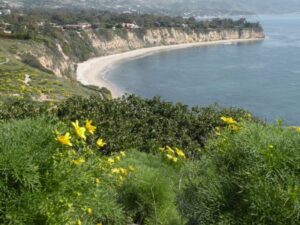
The Malibu Rivera below Point Dume State Beach. Photo courtesy of Linda Ballou.
Solstice Canyon, just north of the Malibu Seafood (officially known as Malibu Seafood Fresh Fish Market & Patio Cafe), my favorite outdoor eatery in Malibu, is close to the coast. An easy paved path takes you to a seasonal waterfall. The longer, more strenuous Sun Rising trail in this park takes you high above the creek that flows through the canyon. Sage scents the air, and wildflowers line the footpath in spring.
Further north on the Coast is Point Dume State Beach, jutting out into the Pacific. It is the perfect place to spot migrating whales traveling from Mexico to Alaska. There is a beach trail at the end of the parking lot at Westward Beach that climbs through a meadow of bright yellow blooms to a viewing platform. Keep going on this track, and you will run into a steep stairwell that takes you down to one of the most remote Malibu beaches left to explore.
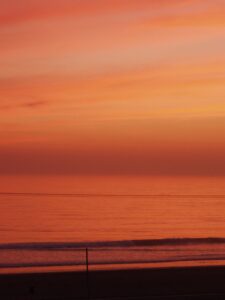
A gorgeous sunset at Trancas Beach, Malibu. Photo courtesy of Linda Ballou.
A bit further up the coast is Trancas Beach with several coastal accesses on Broad Beach Road. This long strand of sand with soft, rolling waves is one of my favorites for beachcombing. Mansions overlook the beach with no trespassing signs, but there is plenty of room for an umbrella and a picnic on the sand at low tide.
Malibu is no stranger to fire, mudslides, and other natural disasters. But thanks to the battle against the drumbeat of progress by May Rindge, the “Queen of Malibu,” it remains a unique, splendid piece of paradise. You will find more information about trails at the Santa Monica Mountains National Recreation Area. The All Trails app is a convenient resource. And finally, here’s an informative video.
In my book Lost Angel in Paradise, I share more information about my favorite stops on the coast from Malibu to Mendocino.
Note: The Getty Villa is not technically in Malibu, but it is located in a canyon along the Pacific Coast Highway, just south of Malibu’s boundaries. It is home to a wonderful art gallery dedicated to antiquities. There is a permanent collection of Roman statuary and artifacts, as well as revolving exhibits. The structure is a replica of a Roman villa and features four gardens with Roman fountains. The Garden and Architecture tour is not to be missed. The Getty Villa is free with an online reservation, but there is a parking fee.

 Linda's mission is to experience as many beautiful places on our planet as she can before they are no more. Travel tales relating her experiences while kayaking, horseback riding, sailing, birding and hiking about the globe have appeared in numerous national magazines. She had great fun collecting travel stories, and profiles of people she met in “naturally high places” for her book, Lost Angel Walkabout-One Traveler’s Tales. Her latest book Lost Angel Unleashed is the third book in her Lost Angel Trilogy
Go to LostAngelAdventures.com for more adventures.
For more about Linda’s novels and media offerings go to. www.LindaBallouAuthor.com


Leave a Reply
You must be logged in to post a comment.